Industry Analysis · March 2026
Why AI Video Translation Matters: The $33 Billion Opportunity Nobody Is Talking About
The market was worth $2.68 billion in 2024. It is projected to hit $33.4 billion by 2034. And most content teams still are not using it. Here is the data behind the shift.
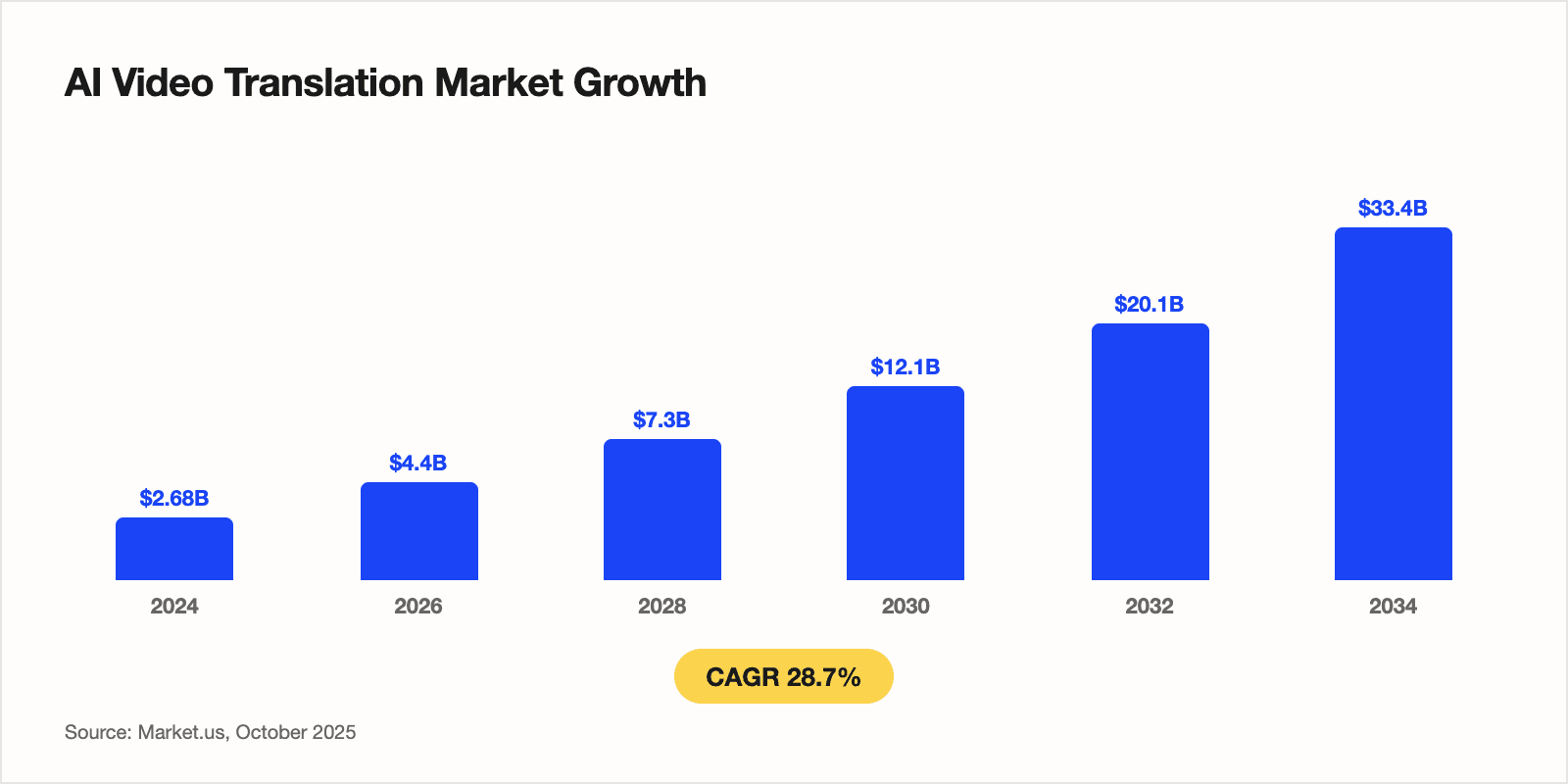
The AI Video Translation Market Is Growing at 28.7% Per Year
The global AI video translation market reached $2.68 billion in 2024 and is projected to grow to $33.4 billion by 2034, according to a 316-page market analysis published by Market.us (October 2025). That is a compound annual growth rate of 28.7% — faster than most segments of the AI industry.
North America currently holds the largest regional share at 36.4% ($0.97 billion in 2024), with the U.S. market specifically growing at 25.3% CAGR. But the real acceleration is happening globally as businesses recognize that video is no longer optional and monolingual content is leaving revenue on the table.
| Metric | Value | Source |
|---|---|---|
| 2024 Market Size | $2.68 billion | Market.us, Oct 2025 |
| 2034 Projected Size | $33.4 billion | Market.us, Oct 2025 |
| CAGR (2025-2034) | 28.7% | Market.us, Oct 2025 |
| North America Share | 36.4% ($0.97B) | Market.us, Oct 2025 |
| Solution vs Service Split | 75.4% solutions | Market.us, Oct 2025 |
Your Audience Already Wants Dubbed Content — The Data Is Clear
Over 60% of YouTube views come from non-English-speaking regions. That is the supply-demand gap in one number: most video content is produced in English, but most video consumption is not.
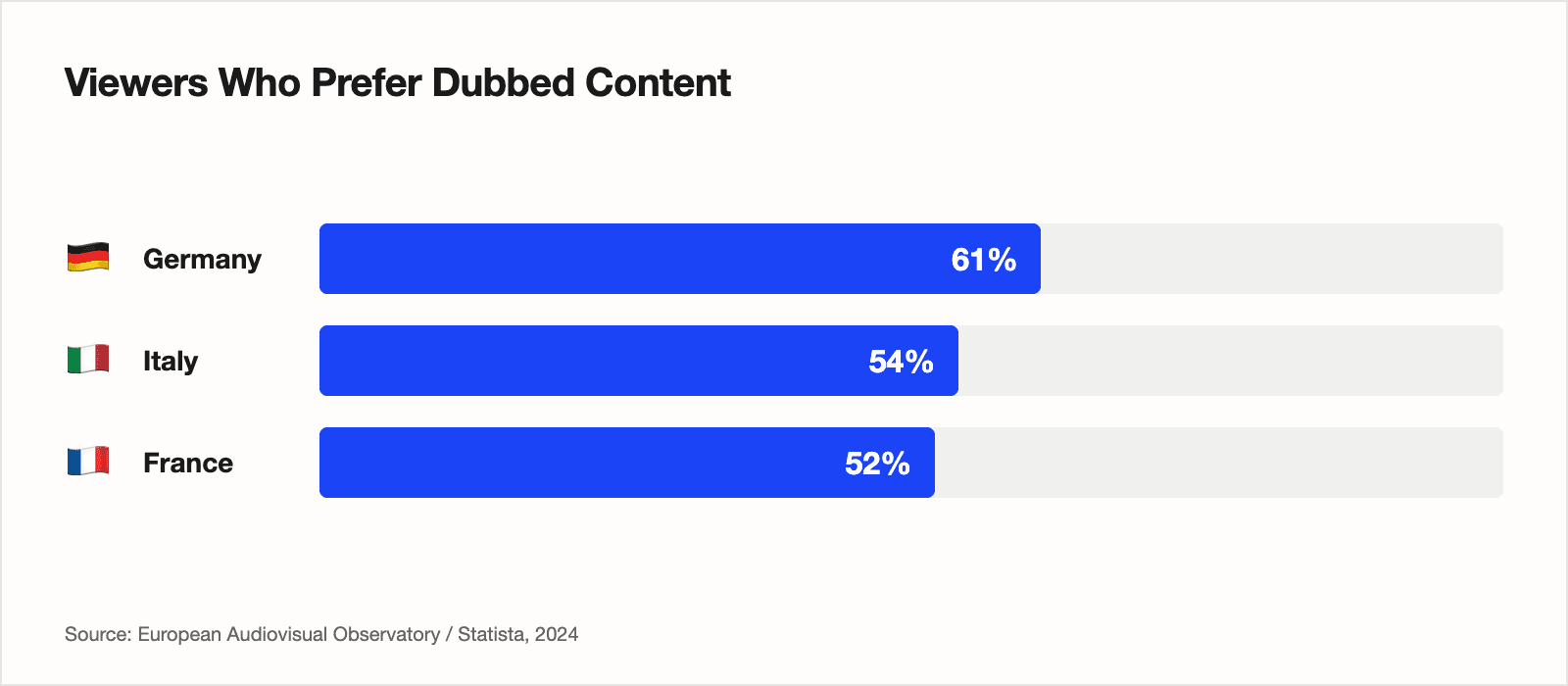
The preference for dubbed content over subtitles is not marginal — it is the majority position in key European markets. 61% of German viewers prefer dubbed content. 54% of Italian viewers. 52% of French viewers. These are not niche audiences. Germany alone is the fourth-largest economy in the world.
| Market | Prefer Dubbed | Implication |
|---|---|---|
| Germany | 61% | Strongest dubbing preference in Europe. GDPR-compliant tools critical. |
| Italy | 54% | Traditional dubbing culture transferring to digital. |
| France | 52% | Strong preference, especially for educational content. |
Traditional Dubbing Costs $50-100 Per Minute. AI Costs $2-20.
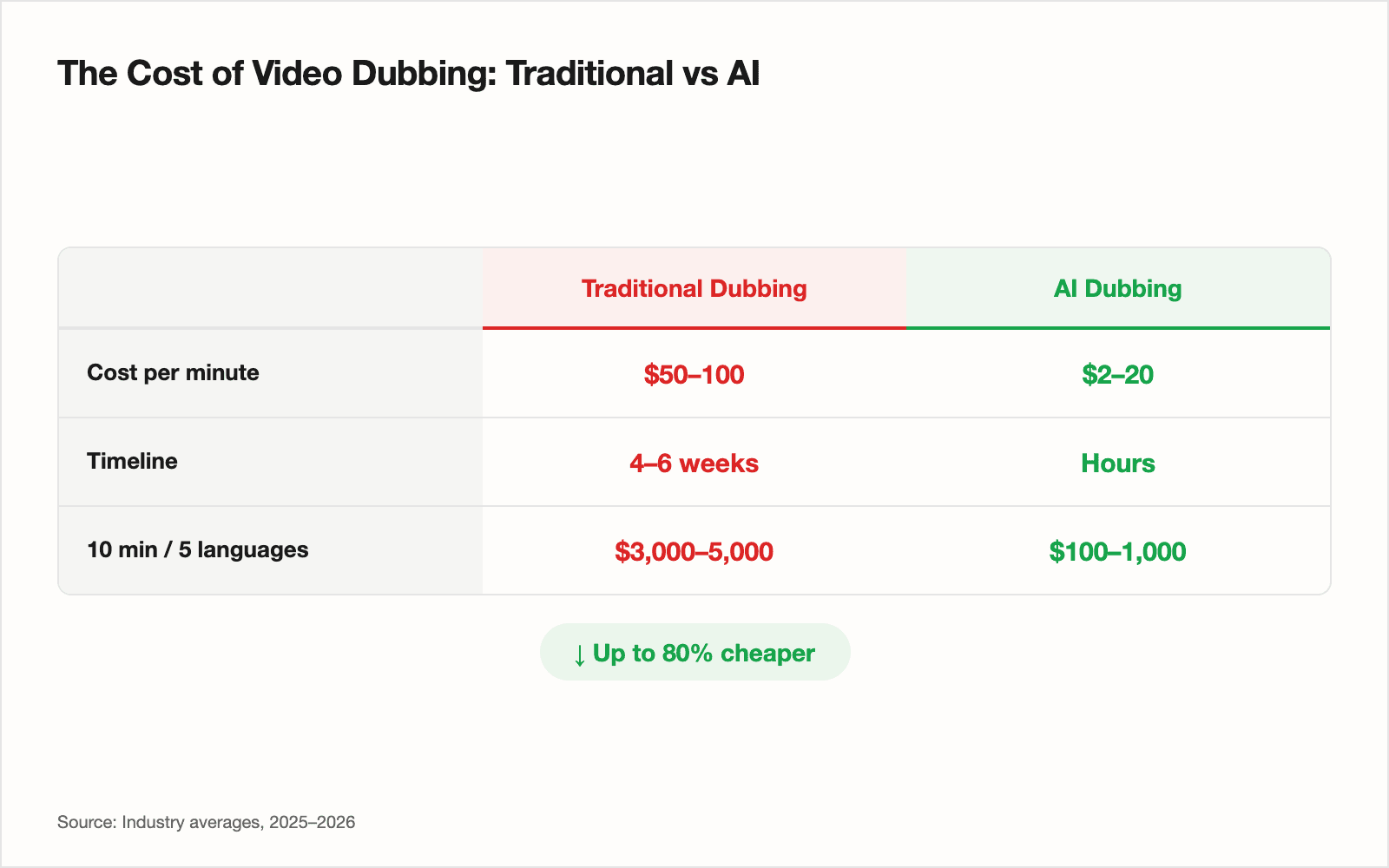
The economics of traditional dubbing have always been the bottleneck. A 10-minute product video dubbed into five languages through a professional agency costs $3,000 to $5,000 and takes four to six weeks. The math does not work for most content teams, so they either produce subtitles (which most viewers skip) or do nothing (which leaves markets untapped).
AI has collapsed both the cost and timeline. Current platforms charge $2-20 per minute depending on whether lip sync is included, and deliver results in hours rather than weeks. The cost reduction is up to 15x compared to traditional methods.
| Factor | Traditional Dubbing | AI Dubbing |
|---|---|---|
| Cost per minute | $50-100 | $2-20 |
| Timeline (10 min video, 5 languages) | 4-6 weeks | Hours |
| Total cost (10 min, 5 langs) | $3,000-5,000 | $100-1,000 |
| Voice consistency | Different actors per language | Cloned original voice |
| Scalability | Linear cost increase | Marginal cost per language |
Adoption Is Happening Across Every Sector — Not Just Media
Content creators hold the largest adoption share at 40.6% of the market, but the technology is spreading rapidly across sectors that most people would not associate with video translation.
E-Learning & Education
40%+ of universities now use AI speech translation. Online course platforms are dubbing entire catalogs to reach global learners. E-learning localization demand has increased 40%.
Corporate Communications
52%+ of businesses now create multilingual promotional videos. Internal training, all-hands meetings, and onboarding content are all being dubbed for global teams.
Entertainment & Streaming
Netflix's 120% increase in dubbed viewership validated the model. AI dubbing delivers approximately 10x speed improvement over traditional methods, making rapid localization for global releases viable.
Government
35-50% of city councils are using or testing AI translation for public communications, accessibility, and multilingual citizen services.
The Quality Gap Between Platforms Is the Decision That Matters Most
The market data tells you that AI video translation is growing. What it does not tell you is that the quality difference between platforms is enormous — and choosing the wrong tool means publishing content that actively damages your brand in the markets you are trying to reach.
In our testing, lip sync quality ranged from Basic to Excellent across leading platforms. At the top end, the results are virtually indistinguishable from native speech. At the lower end, the mismatch between mouth movements and audio is immediately visible. That gap is the difference between content your international audience trusts and content they click away from.
AI translation accuracy currently sits at approximately 90% for general content, with transcription accuracy exceeding 98%. These numbers are strong for most use cases, but domain-specific terminology and brand language still benefit from custom vocabulary features — a capability only some platforms offer.
Key performance benchmarks across the industry
| Metric | Industry Average | Source |
|---|---|---|
| AI transcription accuracy | 98%+ | Market.us, 2025 |
| Translation accuracy | ~90% | Market.us, 2025 |
| Engagement increase (localized video) | +40% | Market.us, 2025 |
| Watch-through improvement | +30% | Market.us, 2025 |
| Languages supported (top platforms) | 38-175 | Our testing, 2026 |
| Lip sync quality range | Basic — Excellent | Our testing, 2026 |
What This Means for Your Content Strategy
75% of marketers report that video translation boosts engagement. 60%+ of video creators are expected to use generative AI by 2025. 40% of marketers already use machine translation for localization. The question is no longer whether to translate your video content but how to do it without wasting budget on a tool that does not deliver quality your audience will accept.
Start with your highest-performing content
Translate the videos that already work in English. Product demos, founder stories, and training content with proven engagement are the lowest-risk starting point.
Choose your tool based on content type, not feature count
A tool with 175 languages and broken lip sync is worse than one with 40 languages and results that look native. Match the tool to whether you need lip sync (real footage) or just audio dubbing (voiceovers, podcasts).
Start with 2-3 target languages, not 20
Focus on the markets with the highest revenue potential. For most European-focused businesses, German (61% prefer dubs), French (52%), and Spanish give you the highest ROI per language added.
Ready to compare tools?
We tested every major AI dubbing platform side by side on identical footage. See which tool fits your use case.
Sources
- AI Video Translation Market Report — Market.us, October 2025. 316 pages. Market sizing, segmentation, regional analysis.
Frequently Asked Questions
How big is the AI video translation market?
The AI video translation market was valued at $2.68 billion in 2024 and is projected to reach $33.4 billion by 2034, growing at a CAGR of 28.7% (Source: Market.us, October 2025). North America holds the largest regional share at 36.4%.
How much cheaper is AI dubbing than traditional dubbing?
AI dubbing reduces costs by up to 15x compared to traditional methods. Traditional professional dubbing costs approximately $50-100 per minute of video. AI platforms have reduced this to roughly $2-20 per minute depending on whether lip sync is included. Production timelines shrink from weeks to hours.
Do viewers actually prefer dubbed content over subtitles?
Yes, particularly in European markets. 61% of German viewers, 54% of Italian viewers, and 52% of French viewers prefer dubbed content over subtitled content. Netflix reported a 120% increase in dubbed program viewership over two years, confirming the demand extends beyond traditional dubbing markets.
How accurate is AI video translation?
Current AI translation systems achieve approximately 90% accuracy for general content. AI transcription accuracy exceeds 98%. However, accuracy varies significantly by language pair, domain-specific terminology, and speaker clarity. Professional review is still recommended for high-stakes content.
Which industries benefit most from AI video translation?
Content creators lead adoption at 40.6% market share, followed by e-learning (40%+ university adoption), corporate communications (52%+ of businesses create multilingual promo videos), entertainment (Netflix, YouTube), and government (35-50% of city councils testing AI translation).
Sources & Further Reading
- AI Video Translation Market Report — Market.us, October 2025
- AI Video Dubbing Market Outlook 2025-2032 — IntelMarketResearch, 2025
- Dubbing Market Size & Statistics 2026-2035 — Business Research Insights, 2026
- Popular YouTube channels produced content in many languages — Pew Research Center, 2019
- YouTube Auto-Dub rolled out to creators — YouTube, 2025