Technology Deep Dive · March 2026
How AI Lip Sync Actually Works: From Phonemes to Pixels
The technology that makes a German speaker appear to speak fluent Japanese — explained from the ground up. No buzzwords, just the actual science.
When you watch a professionally dubbed video and the speaker's lips match the translated audio perfectly, you are seeing the output of one of the most complex problems in computer vision: generating photorealistic facial movements that correspond to speech in a language the speaker never actually spoke.
The quality gap between platforms — where one tool produces output that looks native and another produces visibly broken mouth movements — comes down to how each system solves this problem. Understanding the technology explains why those differences exist.
The Foundation: Phonemes and Visemes
Every spoken language is built from phonemes — the smallest distinct units of sound. English has roughly 44 phonemes. Mandarin Chinese has a different set, including tonal variations that English lacks. Arabic has pharyngeal sounds that produce mouth shapes English speakers never make.
Visemes are the visual counterparts — the mouth shapes you see when someone speaks. Crucially, there are fewer visemes than phonemes because several different sounds look identical on the lips. The sounds /p/, /b/, and /m/ all produce the same bilabial closure — your lips press together the same way for "pat," "bat," and "mat."
| Viseme Group | Phonemes | Mouth Shape | Example Words |
|---|---|---|---|
| Bilabial | /p/, /b/, /m/ | Lips pressed together | pat, bat, mat |
| Labiodental | /f/, /v/ | Upper teeth on lower lip | fan, van |
| Dental | /θ/, /ð/ | Tongue between teeth | think, the |
| Open vowel | /ɑː/, /æ/ | Jaw dropped, mouth wide | father, cat |
| Rounded vowel | /uː/, /oʊ/ | Lips rounded forward | boot, go |
This phoneme-to-viseme mapping is the first challenge in lip sync. When the system receives translated audio in Japanese, it must identify which phonemes are being spoken, map them to the correct visemes, and then generate the corresponding mouth shapes on the original speaker's face — all while preserving their identity, skin texture, lighting, and head position.
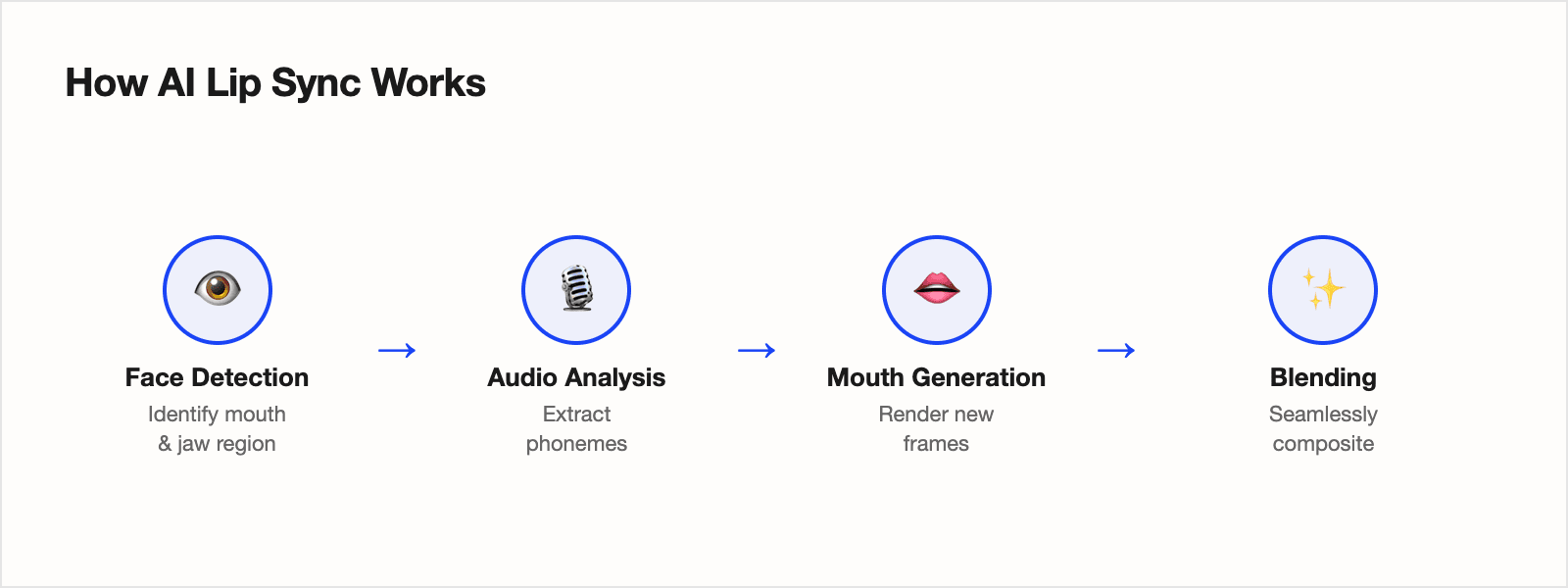
The AI Lip Sync Pipeline: Four Steps
Modern lip sync systems process video through four stages. Understanding these stages explains why some tools handle difficult footage (occlusions, multiple speakers, rapid movement) better than others.
Face Detection & Landmark Mapping
The system identifies all faces in the frame and maps 68-468 facial landmarks — the precise coordinates of eyes, nose, jawline, and crucially, the lip contour. This happens on every single frame. For a 30fps video, that is 1,800 landmark detections per minute of footage.
Audio Analysis & Phoneme Extraction
The translated audio is converted into a mel-spectrogram — a visual representation of the audio's frequency content over time. The Speech Encoder processes this to extract phoneme timing: exactly when each sound starts and ends, down to the millisecond.
Mouth Region Generation
This is where the actual synthesis happens. A generative model (typically a GAN or diffusion model) takes the facial landmarks + phoneme data and generates new pixel values for the mouth region. The original face's upper half is preserved; only the lower face is regenerated.
Blending & Temporal Smoothing
The generated mouth region is blended back into the original frame. Edge artifacts must be eliminated, skin tones must match, and temporal consistency must be maintained — the face cannot flicker or shift between frames.
The Models That Made It Possible
Wav2Lip (2020)
Wav2Lip, published at ACM Multimedia 2020 by researchers from IIIT Hyderabad, was the breakthrough that made practical lip sync on arbitrary faces viable. Its key innovation: a pre-trained "lip-sync expert" discriminator that evaluates whether generated mouth movements actually match the audio.
The architecture has three components: an Identity Encoder (captures the speaker's face using stacked residual convolutional layers), a Speech Encoder (processes mel-spectrograms into speech embeddings), and a Face Decoder (transpose convolutional layers that generate the output frame). The model masks the lower half of the input face during training, forcing it to learn lip movements from audio alone.
GANs and Adversarial Training
Generative Adversarial Networks (GANs) are the backbone of most current lip sync systems. Two neural networks compete: the Generator creates synthetic mouth regions, and the Discriminator tries to distinguish real from generated frames. This adversarial process drives the Generator toward increasingly photorealistic output.
Wav2Lip-HQ extended the original model by adding face parsing (segmenting the face into regions for more precise editing) and super-resolution (upscaling the generated region to match the original video's resolution). This addressed one of Wav2Lip's main limitations: the generated mouth region was often noticeably blurrier than the surrounding face.
Diffusion Models (2024-2026)
The latest generation of lip sync systems uses diffusion models — the same family of architectures behind image generators like Stable Diffusion. Models like VividTalk and MoDiT use 3D morphable face models combined with diffusion transformers, using Wav2Lip output as a motion prior that gets refined to higher quality. These approaches produce more temporally consistent results with fewer artifacts, especially on complex footage with head movement and partial occlusions.
Why Quality Differs So Dramatically Between Platforms
The same underlying research is available to every company. The difference in output quality comes from engineering decisions that compound:
| Challenge | What Breaks | How the Best Systems Handle It |
|---|---|---|
| Occlusions | Hands, microphones, or glasses covering the mouth | Temporal prediction: infer mouth shape from surrounding frames + audio, fill in occluded pixels |
| Profile shots | Only partial lip visible at steep angles | 3D face model reconstruction: understand the face in 3D, generate correct perspective |
| Multi-speaker | Multiple faces, each speaking different audio | Speaker diarization + facial tracking: assign each voice to the correct face automatically |
| Rapid movement | Head turns, gestures cause landmark tracking to drift | Optical flow stabilization: track the face as a rigid body through motion, re-project landmarks |
| Resolution mismatch | Generated mouth region looks blurry or artificially smooth | Super-resolution + texture transfer: match the generated region's texture to the original skin |
| Temporal flickering | Frame-by-frame generation causes visible jitter | Temporal discriminator: additional GAN component that penalizes inconsistency across frames |
Platforms that were built specifically for dubbing real footage from the ground up have typically invested more in these edge cases than platforms that started with avatar synthesis and added real-footage dubbing later. The avatar problem is fundamentally easier — you control the lighting, the face geometry, and the camera angle. Real footage has none of those guarantees.
Beyond Dubbing: Where Lip Sync Technology Is Used
Video dubbing is the most visible application, but the same core technology powers:
- →Film and TV post-production
— fixing dialogue in scenes where the original audio was unusable, without requiring actors to return for ADR (automated dialogue replacement).
- →Accessibility
— generating sign language avatars that speak translated content with accurate lip movements for hearing-impaired viewers.
- →Gaming and VR
— real-time lip sync for NPC dialogue. Technologies like Meta's OVR Lip Sync process audio at 100fps and output viseme weights for game engine characters (Meta Developer Docs).
- →Teleconferencing
— NVIDIA's Audio2Face generates facial animations from audio in real-time using 52 ARKit blend shapes, enabling low-bandwidth video calls where only audio is transmitted and the face is reconstructed client-side.
The Ethics Question
The same technology that enables a CEO to address employees in 40 languages can be used to put words in someone's mouth they never said. The deepfake concern is real and worth addressing directly.
Responsible platforms mitigate this through consent verification (requiring proof you have rights to the footage), watermarking (embedding invisible markers in generated video), and audit trails (logging who processed what content). GDPR-compliant platforms add an additional layer: the original footage and generated output must be processed and stored under the same data protection framework.
The technology itself is neutral. The difference is in governance — who has access, what safeguards exist, and whether the platform treats video content as personal data (which, under EU law, it is when it contains identifiable faces).
Now compare the tools that use this technology
See how different platforms apply these techniques — and where each one excels or falls short.
Sources
- A Lip Sync Expert Is All You Need for Speech to Lip Generation In the Wild — Prajwal et al., ACM Multimedia 2020. The Wav2Lip paper.
- Can One Model Fit All? Wav2Lip's Lip-Syncing Generalizability Across Languages — Springer, 2024. Cross-lingual evaluation.
- Perceptual Synchronization Scoring Using Phoneme-Viseme Agreement — Gupta et al., WACV 2024. Benchmarking methodology.
- Lip Syncing AI Characters: Techniques and Future Trends — Convai, 2025. Industry overview.
- Viseme — Wikipedia. Foundational definitions.
- Phoneme — Wikipedia. Foundational definitions.
Frequently Asked Questions
What is AI lip sync?
AI lip sync is a technology that uses deep learning to modify a speaker's visible mouth and facial movements in video so they match audio in a different language. The system analyzes the original face frame-by-frame, maps facial landmarks, then generates new mouth movements matching the translated audio's phonemes. Modern systems use generative adversarial networks (GANs) and diffusion models to produce photorealistic results.
What is the difference between visemes and phonemes?
Phonemes are the smallest distinct units of sound in a language — English has roughly 44 phonemes. Visemes are the visual mouth shapes that correspond to those sounds. There are fewer visemes than phonemes because several different sounds look the same on the lips (for example, 'p', 'b', and 'm' all produce the same bilabial closure). AI lip sync systems must map audio phonemes to the correct visual visemes to produce convincing mouth movements.
What is Wav2Lip and how does it work?
Wav2Lip is a foundational AI model for lip synchronization, published at ACM Multimedia 2020 by researchers from IIIT Hyderabad. It uses an encoder-decoder architecture with three components: an Identity Encoder that captures the speaker's face structure, a Speech Encoder that processes audio mel-spectrograms, and a Face Decoder that generates new mouth movements. A pre-trained lip-sync discriminator ensures audio-visual alignment. Wav2Lip works on arbitrary faces and audio, making it effective for dubbing real footage.
Why does lip sync quality vary so much between AI dubbing tools?
Quality depends on the underlying model architecture, training data, and engineering focus. Avatar-first platforms trained their lip sync on synthetic faces, which is a fundamentally different problem than syncing real human footage. Key differentiators include occlusion handling (what happens when hands cover the face), multi-speaker detection, temporal consistency (no flickering between frames), and the resolution of the generated face region. Platforms purpose-built for video dubbing typically outperform those that added dubbing as a secondary feature.
Can AI lip sync handle multiple languages?
Yes, but with varying quality. Different languages have different phoneme inventories and therefore different viseme mappings. English has roughly 44 phonemes; Mandarin Chinese has different tonal characteristics that affect mouth shape. The best systems use language-specific phoneme-to-viseme mappings developed with linguists. Systems that use a single universal model across all languages tend to produce less accurate mouth movements for non-English content.
Sources & Further Reading
- How AI Dubbing Is Reshaping Global Media — Slator, 2025
- AI dubbing in 2026: the complete guide — RWS, 2026
- AI Dubbing 2025: How Technology is Transforming Video Localization — Speeek, 2025